Unlock the mysteries of whiskey with ‘Uncasked Secrets’. Explore the diverse barrel types and the art of aging, and see how they shape your favorite drink’s character. Dive deep into the heart of whiskey craftsmanship.
Introduction to Whiskey Barrel Aging
There’s a reason the saying “aging like a fine whiskey” has withstood the test of time.
Whiskey aging, an intricate and time-honored tradition, is the unsung hero behind your favorite distilled spirits. It plays a key role in refining the taste and enhancing the quality of whiskey.
From the mighty oak barrels of the Kentucky Bourbon Trail to the Japanese Mizunara casks, aging whiskey is a complex process that transforms raw spirits into liquid gold.
Understanding Whiskey Types
When it comes to whiskey, one size doesn’t fit all.
Various whiskey types—Scotch, Bourbon, Rye, and more—each bring a unique set of aging requirements to the table.
Scotch, for instance, must be aged for a minimum of three years in oak casks, while bourbon, a distinctively American spirit, ages in brand-new charred oak barrels.
Each whiskey type, with its specific barrel and aging process, ultimately delivers a distinct flavor profile and a unique whiskey experience.
Check out more details about Whiskey types here
| Whiskey Type | Origin | Minimum Aging Time |
| Scotch | Scotland | 3 years |
| Bourbon | United States (mainly Kentucky) | 2 years |
| Rye | United States and Canada | U.S.: 2 years (for “Straight Rye”); Canada: No minimum |
| Irish Whiskey | Ireland | 3 years |
| Japanese Whisky | Japan | No legal minimum, but often aged between 3 and 12 years |
The Materials: Oak and Beyond
When it comes to the art of whiskey aging, oak takes center stage. Renowned for its robust character and sturdiness, oak has long been the preferred choice of distillers around the globe.
However, the choice of oak is not arbitrary; it is the result of careful consideration of a variety of factors that contribute significantly to the final product’s taste and quality.
Why Oak for Whiskey Aging?
Here’s an interesting fact: not all oak is created equal. Different types of oak offer varying flavors and characteristics.
For instance, American white oak, a favorite among Bourbon distillers, is lauded for its high levels of vanillin, lending a sweet vanilla flavor to the whiskey.
On the other hand, European oak, used extensively in aging Scotch, imparts a range of flavors, from dried fruits to spices, thanks to its higher tannin content.
The magic of oak doesn’t stop at flavor infusion. Its semi-permeable nature allows the whiskey to “breathe” in the barrel.
This interaction with the air facilitates oxidation, a chemical process that mellows the harsh alcohol notes while enhancing the more desirable flavors. It also encourages the evaporation of both water and alcohol, a process fondly called the “angel’s share” in distillery lingo.
Beyond Oak: Exploring Alternative Woods
While Oak continues to be the front-runner in whiskey aging, a few maverick distillers have been pushing the boundaries by experimenting with alternative woods. Let’s take a quick peek into this exciting terrain.
Japan offers a brilliant example with its indigenous Mizunara oak. Whiskeys aged in Mizunara barrels, like some premium offerings from Suntory, are revered for their complex flavor profiles featuring sandalwood, coconut, and oriental incense.
However, working with Mizunara isn’t easy due to its porous nature and the fact that the trees take centuries to mature enough for barrel production.
Then we have the French distillers who use Limousin oak, known for its tight grain and low levels of tannins, to age their Cognac and some whiskeys.
The result is a spirit that has a softer tannic influence and a unique fruit-forward profile.
Some craft distilleries in the U.S. are also experimenting with woods like maple and hickory with the aim of carving out a unique space in a crowded market. These woods lend a distinctive character to the whiskey, with flavors ranging from sweet and creamy to bold and smoky.
While these alternative woods are yet to gain mainstream acceptance in the whiskey world, their usage underlines an important fact: the landscape of whiskey aging is as dynamic as the spirit itself. It’s an ongoing journey of exploration and discovery, one where tradition meets innovation, leading to the creation of a spirit that’s truly worth savoring.
Anatomy of a Whiskey Barrel
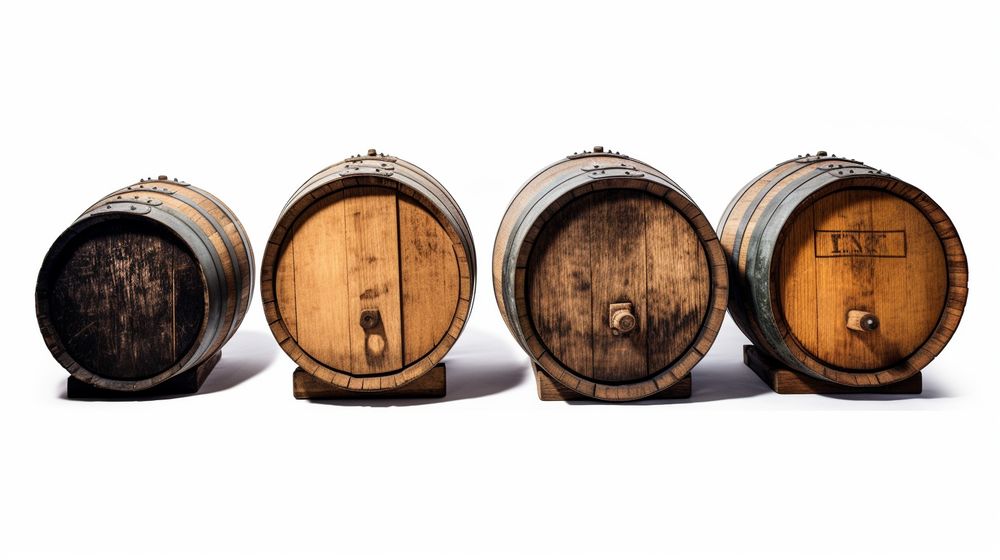
A whiskey barrel is more than just a hollow cylinder made of wood. Its construction is a factor in the aging process.
The staves, or the wooden planks that form the barrel, and the barrel head are charred or toasted to varying degrees.
This charing contributes to the color and flavors of the whiskey, creating a caramelized layer that the spirit can interact with during aging.
- Staves: These are the elongated wooden pieces that form the body of the barrel. The thickness, length, and curvature of the staves influence the whiskey’s contact with the wood and thus the aging process.
- Heads: These are the circular wooden pieces that seal the top and bottom of the barrel. They ensure the whiskey stays within the barrel during the aging process.
- Charred Interior: The inner surface of the barrel is toasted and then charred. This charred layer gives whiskey its beautiful amber color and contributes to flavor development.
- Bung Hole: This is the opening usually positioned around the middle of the barrel. It is where the whiskey enters and exits the barrel.
- Bung: This is the stopper, often made of wood, that fits into the bunghole. It prevents the whiskey from leaking out during the aging process and is removed when distillers need to sample the aging whiskey.
The Science of Aging Whiskey
Aging whiskey isn’t just an art; it’s a science. As the whiskey ages, a complex series of chemical reactions occur.
Compounds within the wood interact with the spirit, leading to the evaporation of undesirable flavors and the absorption of desirable ones.
This interaction imbues the whiskey with its distinct flavor, aroma, and color, making aging an essential process in whiskey production.
| Process | Description |
| Absorption | The whiskey absorbs flavors from the charred interior of the barrel, influencing its taste and color. |
| Oxidation | The semi-permeable nature of the barrel allows the whiskey to interact with air, smoothing harsh alcohol notes and enhancing flavors. |
| Evaporation | Over time, some of the whiskey (and water) evaporates through the barrel, known as the “angel’s share.” This affects the concentration and flavor of the remaining spirit. |
| Temperature Fluctuation | Changes in temperature cause the whiskey to expand and contract, influencing how deeply it penetrates the barrel’s wood and how much flavor it absorbs. |
| Time | The longer a whiskey is aged, the more flavor it can potentially absorb from the barrel, up to a certain point. After that, it may lose too much alcohol content or develop overly oaky flavors. |
The Art of Cooperage: Barrel Making
In a world of cutting-edge technology and automation, you’d be surprised at how much barrel making remains a hands-on, painstaking craft.
We owe a large chunk of whiskey’s character to the coopers’ skills. It’s they who meticulously shape and char the barrels, defining a good part of the environment in which the whiskey will age.
It all starts with the selection of wood. The vast majority of whiskey barrels are made from oak, chosen for its strength, workability, and, most importantly, its rich cocktail of flavor compounds.
Coopers then cut and shape the staves, curving them to form the body of the barrel.
Then comes the all-important step: charring or toasting the interior of the barrel. This process caramelizes the wood’s sugars, forming a layer of red-hot charcoal on the inner surface.
This layer acts as a kind of flavor sponge, imparting a range of delectable notes to the maturing whiskey.
Exploring Barrel Sizes
When it comes to whiskey barrels, one size definitely does not fit all.
Barrel size can significantly impact the aging process and the resulting whiskey’s flavor. Let’s take a look at a few common types.
The standard barrel in the bourbon industry is the American Standard Barrel, coming in at a hefty 53 gallons. This size offers a good balance between the whiskey’s interaction with the wood and the rate of evaporation, yielding a consistent flavor profile that bourbon drinkers know and love.
On the smaller end of the spectrum, we have quarter casks with a capacity of just 13 gallons.
The increased surface area-to-volume ratio means the whiskey matures faster as it interacts more with the wood. It’s a good option for distilleries wanting to get their product to market quicker, but beware: over-aging in small barrels can lead to an overly oaky whiskey.
New vs. Used Barrels
There’s an interesting divide in the whiskey world when it comes to barrels.
On one side, you have the likes of bourbon, which, by law, must be aged in new, charred oak barrels. On the other side, you have Scotch and many other whiskies, which are traditionally aged in used barrels.
Aging whiskey in new barrels imparts strong, wood-forward flavors, contributing to bourbon’s characteristic vanilla and caramel sweetness.
Used barrels, on the other hand, have already had many of their strongest flavors leached out by previous occupants (often bourbon or sherry). As a result, they impart more subtle, nuanced flavors to the whiskey.
| New Barrels | Used Barrels |
| Maker’s Mark (Bourbon) | Macallan (Scotch) |
| Woodford Reserve (Bourbon) | Glenfiddich (Scotch) |
| Jack Daniel’s (Tennessee Whiskey) | Redbreast (Irish Whiskey) |
| Buffalo Trace (Bourbon) | Jameson (Irish Whiskey) |
| Jim Beam (Bourbon) | Lagavulin (Scotch) |
Please note that Bourbon, by legal requirement in the U.S., must be aged in new charred oak barrels.
Scotch whisky, on the other hand, is often aged in used barrels that previously held bourbon or sherry, although this can vary.
Some Scotch whiskies are also aged in new oak barrels, so it’s not an absolute rule.
Other types of whiskey, like Irish whiskey or Canadian whiskey, also commonly use used barrels, but it varies by brand and product.
Climate Influence on Whiskey Aging
Climate plays a huge role in the aging of whiskey. In fact, it’s one of the main reasons why a Kentucky bourbon and a Scotch whisky, aged for the same amount of time, can taste so different.
A hot, dry climate, like that of Kentucky, accelerates the aging process, extracting flavors from the wood more quickly. It also increases the rate of evaporation of water more than alcohol, leading to a higher proof of bourbon.
Conversely, the cool, damp climate in Scotland slows the aging process and results in a higher rate of alcohol evaporation, leading to lower-proof Scotch.
Choosing Your Whiskey
Understanding the ins and outs of barrels and aging is like having a cheat sheet when choosing your whiskey. You’ll start to recognize why certain whiskies taste the way they do and what to expect from different types of whiskey.
Whether you’re a fan of the bold, rich flavors of a new barrel-aged bourbon or the subtle complexities of a Scotch aged in used barrels, it’s all a matter of personal preference.
There’s a world of flavors out there, just waiting to be discovered. So, here’s to the barrels, the unsung heroes of the whiskey world, and to you, the curious whiskey explorer. Happy tasting!
Learn more about the difference between Scotch and Bourbon whiskey.
Frequently Asked Questions on Whiskey Barrel Types and Aging
What is the best type of barrel for aging whiskey?
Oak is the preferred choice for aging whiskey due to its strength, workability, and flavor-enhancing qualities. However, other types of wood, like maple, cherry, or hickory, can be used to add unique flavors.
How long does whiskey need to age?
The aging process for whiskey varies greatly, from a few years to several decades. The age stated on a whiskey bottle refers to the youngest whiskey in the blend. Aging time can significantly impact the flavor and smoothness of the whiskey.
Why is bourbon always aged in new barrels?
By U.S. law, bourbon must be aged in new, charred oak barrels. This is to ensure the strong, distinct flavors, including vanilla and caramel, that bourbon is known for.
Does the size of the barrel affect the flavor of the whiskey?
Yes, the size of the barrel can greatly affect the flavor of the whiskey. Smaller barrels increase the surface area-to-volume ratio, which accelerates maturation and adds more wood character to the whiskey.
Can you tell what type of barrel a whiskey was aged in based on its flavor?
Yes, experienced tasters can often discern the type of barrel used from the unique flavor profile it imparts to the whiskey. For instance, new oak barrels often lend strong vanilla and caramel notes to the whiskey.